
debut album // Sep 25, 2026
Multimedia Audio Composition; Compilation of Original Music Compositions across Various Formats
For Stereo Speakers (00:37:53)
For Stereo Speakers (00:37:53)
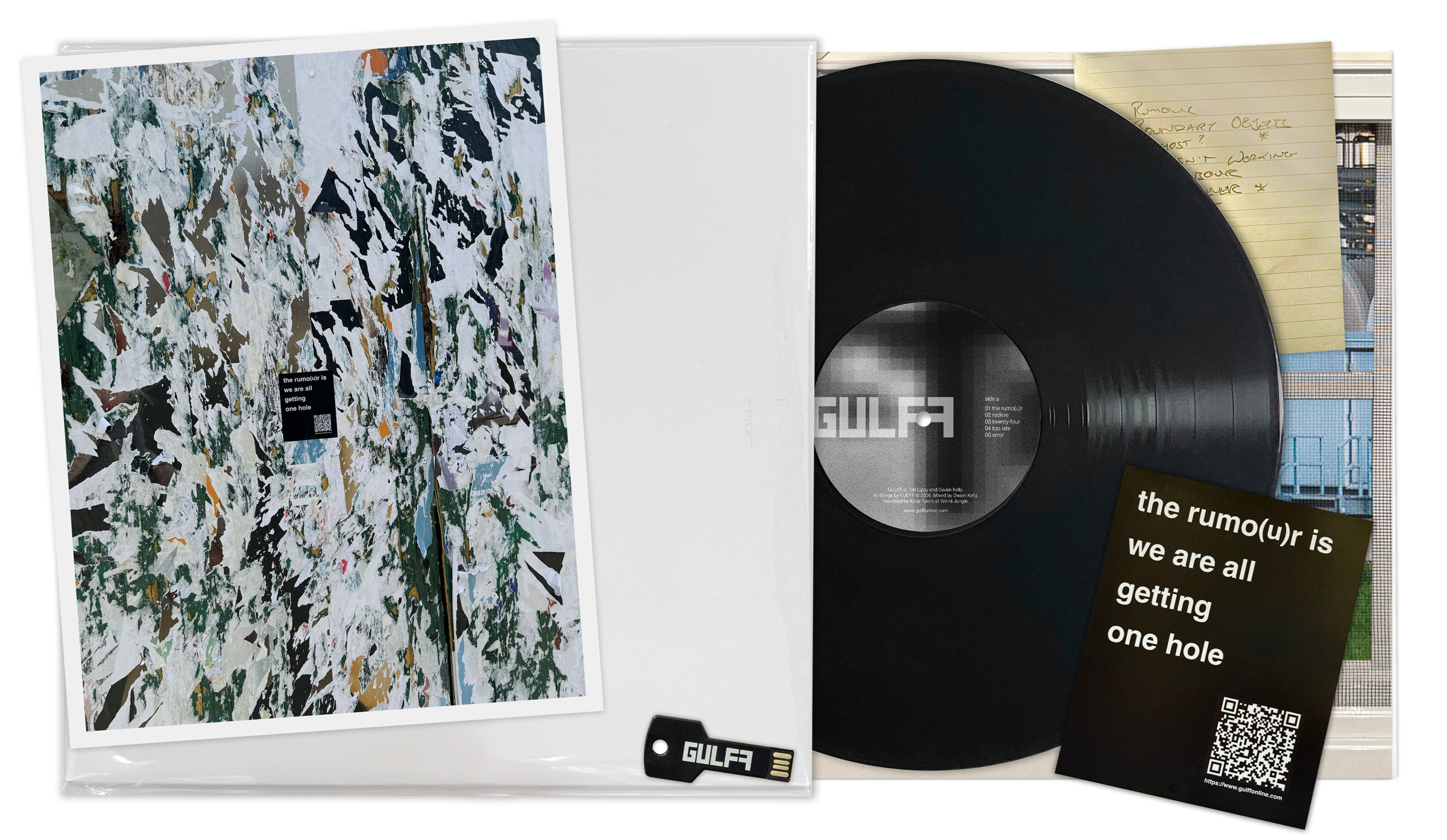
GULFF - Limited Edition 12" Vinyl LP (Artist's Edition of 50)
PURCHASE HERE
12” vinyl record (edition of 50) that includes facsimile copies of process-related documents, a signed-and-numbered limited-edition photographic print by Lippy, a 20x23” fold-out poster related to GULFF’s Data Center Listening Station installation at NYC’s Printed Matter Bookstore, and a sticker.
Also included: a customized flash drive with uncompressed audio files of the album tracks, an ambient track inspired by the songs from Kelly, Lippy’s rough demos, stem files for remixing, and an “Archive” folder containing process-related audio, visual, and video files.
Also included: a customized flash drive with uncompressed audio files of the album tracks, an ambient track inspired by the songs from Kelly, Lippy’s rough demos, stem files for remixing, and an “Archive” folder containing process-related audio, visual, and video files.
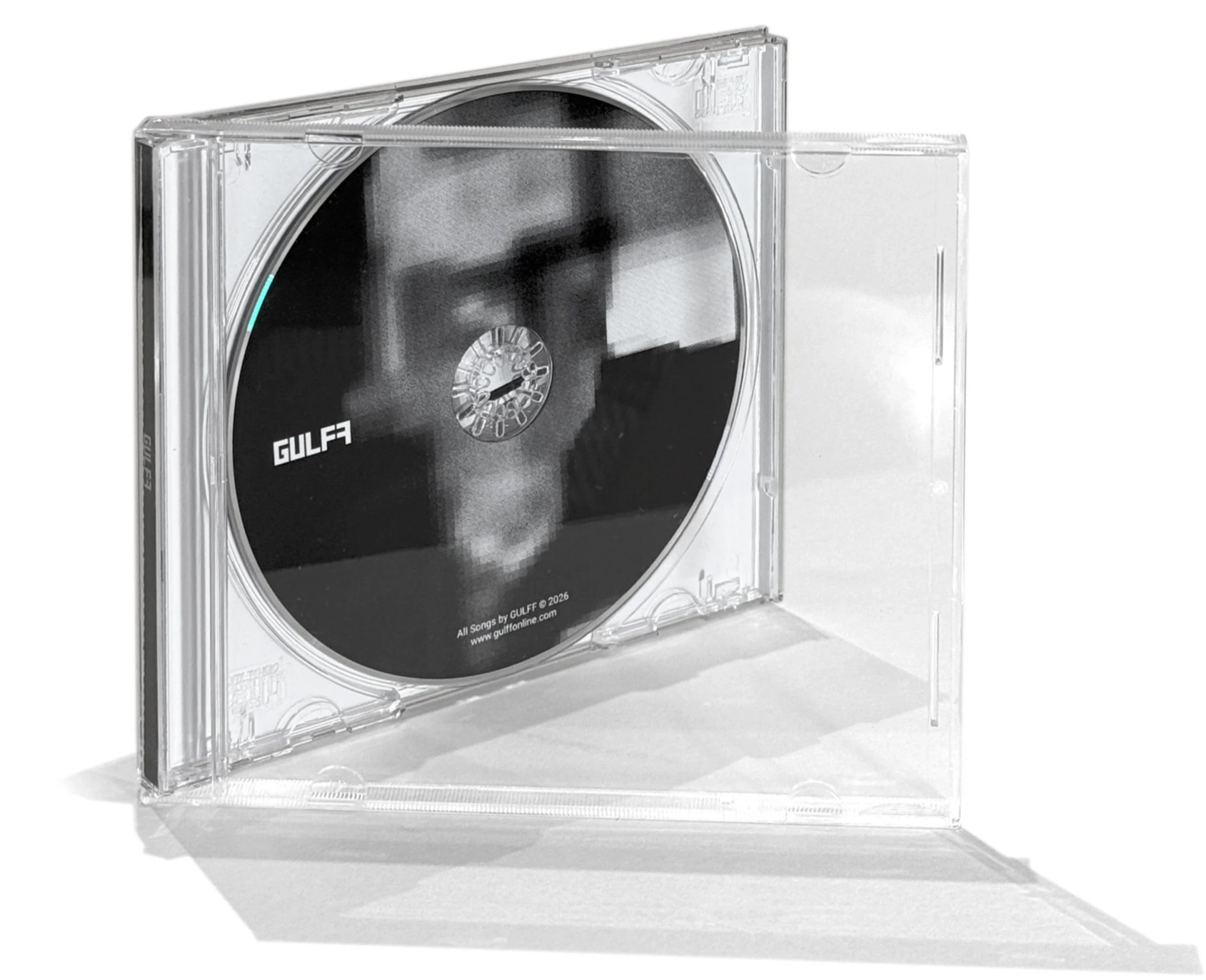
GULFF - Limited Edition Compact Disc
PURCHASE HERE
10-song CD in clear jewel case with screen-printed artwork by GULFF.
Includes digital pre-order of GULFF. You get 3 tracks now (streaming via the free Bandcamp app and also available as a high-quality download in MP3, FLAC and more), plus the complete album the moment it’s released. Download available in 24-bit/48kHz.
Includes digital pre-order of GULFF. You get 3 tracks now (streaming via the free Bandcamp app and also available as a high-quality download in MP3, FLAC and more), plus the complete album the moment it’s released. Download available in 24-bit/48kHz.
GULFF - Digital Album
PURCHASE HERE
Digital pre-order of GULFF. You get 3 tracks now (streaming via the free Bandcamp app and also available as a high-quality download in MP3, FLAC and more), plus the complete album the moment it’s released. Download available in 24-bit/48kHz.
The rumo(u)r is we’re all getting one hole.
The album opens with the rumo(u)r and its beats built from the monstrous soundscape of the physical infrastructure of artificial intelligence. Kelly builds the track from broadcast newscasts about the low-frequency hum of data centers in residential neighbo(u)rhoods — residents describing a noise that penetrates walls and car windows and falls outside most local noise ordinances. Under a momentous digital pulse, static fights Lippy's auto-tuned vocals, which sound as if they’re being broadcast from inside server room. "It's the auditory byproduct of the time we're living in," Kelly says of the single — "noise we're forced to hear and at the same time not supposed to notice."
The band released the track during AI Week NYC alongside "Data Center Noise," a four-day personal listening installation at Printed Matter in NYC, featuring footage crowdsourced from residents near data centers. Lippy's video layers data center maps, thermal imaging, sound waves, AI-generated advertising, and phone footage of a malfunctioning dancing robot. The GULFF Artist Edition's sticker carries the rumo(u)r’s refrain: "the rumo(u)r is we are all getting in one hole.”
The album opens with the rumo(u)r and its beats built from the monstrous soundscape of the physical infrastructure of artificial intelligence. Kelly builds the track from broadcast newscasts about the low-frequency hum of data centers in residential neighbo(u)rhoods — residents describing a noise that penetrates walls and car windows and falls outside most local noise ordinances. Under a momentous digital pulse, static fights Lippy's auto-tuned vocals, which sound as if they’re being broadcast from inside server room. "It's the auditory byproduct of the time we're living in," Kelly says of the single — "noise we're forced to hear and at the same time not supposed to notice."
The band released the track during AI Week NYC alongside "Data Center Noise," a four-day personal listening installation at Printed Matter in NYC, featuring footage crowdsourced from residents near data centers. Lippy's video layers data center maps, thermal imaging, sound waves, AI-generated advertising, and phone footage of a malfunctioning dancing robot. The GULFF Artist Edition's sticker carries the rumo(u)r’s refrain: "the rumo(u)r is we are all getting in one hole.”
Why should a person be saved, who makes no effort to save another?
redline starts out with spooky, overheard, plaintive humming and strumming washed into an eerily seductive, textural series of instrumental beat sequences by composer Kelly. The lyric "no more dreams” stems from the possible psychological byproduct of over-eager AI use, inspired by the moment Lippy typed "dreams" and "AI" into Google and got back a Gemini-generated answer warning that over-reliance on AI tools "could lead to cognitive offloading and decreased critical thinking skills" with consequences for "the deep, reflective thinking that might be associated with dream experiences."
The refrain “save me” follows samples of an army of false helpers: scam robocalls that hit Lippy's phone three or more times a day, with the same script delivered by concerned-sounding "people" whose names and sexes were interchangeable and ever-changing. It is the album's most explicitly political song, with lyrics that call out anti-savio(u)rs from far-right Christian nationalists to ICE. Lippy calls it "a thesis statement for the entire album (and the entire GULFF project).”
redline starts out with spooky, overheard, plaintive humming and strumming washed into an eerily seductive, textural series of instrumental beat sequences by composer Kelly. The lyric "no more dreams” stems from the possible psychological byproduct of over-eager AI use, inspired by the moment Lippy typed "dreams" and "AI" into Google and got back a Gemini-generated answer warning that over-reliance on AI tools "could lead to cognitive offloading and decreased critical thinking skills" with consequences for "the deep, reflective thinking that might be associated with dream experiences."
The refrain “save me” follows samples of an army of false helpers: scam robocalls that hit Lippy's phone three or more times a day, with the same script delivered by concerned-sounding "people" whose names and sexes were interchangeable and ever-changing. It is the album's most explicitly political song, with lyrics that call out anti-savio(u)rs from far-right Christian nationalists to ICE. Lippy calls it "a thesis statement for the entire album (and the entire GULFF project).”
‘24 was the year Trump was reelected, and the year Lippy disconnected with the handful of close friends he had who continued to support Trump. Once again, a musical composition from Kelly inspired twenty-four. A few years back, he’d been experimenting with writing “oddly realised production Muzak,” as a result of working on a surrealist film about the kidnapping of a fashion buyer. “I’d been interested in how you could subvert the typical expectations of background music by writing in non-typical time signatures and using uneven phrasing,” Kelly recalls. “You get some lovely moments of polymetric looping (a 4/4 loop rendered in 3-bar phrases, under a song written in 8-bar phrasing) among the more typically expected verse/chorus structure.”
This bed supports the lyrics, which tell the story of a childhood friend who gave something to the narrator in high school, “something dear, something sweet,” that the giver implored them not to lose. The narrator ultimately lost both the gift and the friend. Is the “loss” a death or simply a loss of connection? At the beginning, a field recording pulled from a British shopping channel, underscored with a piece of hold music, features hosts *oohing* and *aahing* over a piece of jewellery (something dear, something sweet?) with palpable insincerity. For the closing section Kelly wanted real strings, then chose a Mellotron instead: a warm, endlessly looping proxy for reality that mirrors the QVC experience.
This bed supports the lyrics, which tell the story of a childhood friend who gave something to the narrator in high school, “something dear, something sweet,” that the giver implored them not to lose. The narrator ultimately lost both the gift and the friend. Is the “loss” a death or simply a loss of connection? At the beginning, a field recording pulled from a British shopping channel, underscored with a piece of hold music, features hosts *oohing* and *aahing* over a piece of jewellery (something dear, something sweet?) with palpable insincerity. For the closing section Kelly wanted real strings, then chose a Mellotron instead: a warm, endlessly looping proxy for reality that mirrors the QVC experience.
“I received a very chaotic demo from Tod that was bristling with energy, urgency and frustration, and felt no real desire to overproduce something that would inevitably lose that immediacy,” Kelly recalls. “I decided to leave the vast majority of the demo instruments intact — something I’d done sparingly elsewhere but never to this extent — and instead simply added some motion and drama by sampling U.S. Marine Corps marching bands and celebrations during the Ryder Cup, both fine examples of the jingoistic pomp and ceremony befitting our times.”
The resulting track is a a quirky paean of collective sociocultural apathy — the refusal of educated, relatively comfortable, otherwise-engaged people to deal impactfully with the potentially destructive forces in our lives… until they realize they failed to act: “Now it’s too late. Guys, it’s too late. Oh fuck it’s too late. Too late.”
The resulting track is a a quirky paean of collective sociocultural apathy — the refusal of educated, relatively comfortable, otherwise-engaged people to deal impactfully with the potentially destructive forces in our lives… until they realize they failed to act: “Now it’s too late. Guys, it’s too late. Oh fuck it’s too late. Too late.”
Are you happy with the way things are?
The last song on side one of the vinyl album opens with a field recording Kelly made in Manchester of a street preacher proclaiming his faith over traffic, and ends on a customer-service hold line. In between, the lyrics cycle through the language of systems failing — "this field is required," "this key has expired" — swapping words until the error messages describe something else: "this sea has retired," "this greed is required." The track is built from sampled hold music, robocalls, and automated messages. The video was cut from stock footage of the first known internet advertisement, distorted and re-recorded through successive eras of playback technology.
The last song on side one of the vinyl album opens with a field recording Kelly made in Manchester of a street preacher proclaiming his faith over traffic, and ends on a customer-service hold line. In between, the lyrics cycle through the language of systems failing — "this field is required," "this key has expired" — swapping words until the error messages describe something else: "this sea has retired," "this greed is required." The track is built from sampled hold music, robocalls, and automated messages. The video was cut from stock footage of the first known internet advertisement, distorted and re-recorded through successive eras of playback technology.
What is the difference between a FitBit and an ankle monitor?
An intimate song of love, loss and longing. A mediation on surveillance culture. A text on a safe arrival home. A recording of your every move. A security system. A stalker. All of the above. Musically, ever interested what he sees as the “lost promise” of the technological age, Kelly took his inspiration from the faltering line between the palpable optimism that accompanied the advancement of connective technologies on the mid- to late-20th century to the near-constant cynicism now surrounding the greatest communication technology ever realized.
The 2600hz tones that weave throughout this track are all taken from archival footage of phone phreaking techniques, wherein pre-Internet “hackers” would hijack the communications tech used to facilitate long-distance calls so they could communicate with anyone they wanted to, anywhere in the world, for free. “The thrill of such an activity can appear mundane from our internet-equipped perspective, yet it was both subversive and illegal, and phreakers were careful to protect their identities from prying ears,” Kelly says. “Worldwide, affordable communication is no longer subversive, and whilst superficially free, the cost is paid in other ways - harvesting data, extracting profit and constantly surveilling. In legalising and universalising phreaking objectives, we’ve ceased to protect our identities and surrendered our concerns for privacy.” Is it too late to withdraw consent for all this? Will we ever be able to disappear again?
An intimate song of love, loss and longing. A mediation on surveillance culture. A text on a safe arrival home. A recording of your every move. A security system. A stalker. All of the above. Musically, ever interested what he sees as the “lost promise” of the technological age, Kelly took his inspiration from the faltering line between the palpable optimism that accompanied the advancement of connective technologies on the mid- to late-20th century to the near-constant cynicism now surrounding the greatest communication technology ever realized.
The 2600hz tones that weave throughout this track are all taken from archival footage of phone phreaking techniques, wherein pre-Internet “hackers” would hijack the communications tech used to facilitate long-distance calls so they could communicate with anyone they wanted to, anywhere in the world, for free. “The thrill of such an activity can appear mundane from our internet-equipped perspective, yet it was both subversive and illegal, and phreakers were careful to protect their identities from prying ears,” Kelly says. “Worldwide, affordable communication is no longer subversive, and whilst superficially free, the cost is paid in other ways - harvesting data, extracting profit and constantly surveilling. In legalising and universalising phreaking objectives, we’ve ceased to protect our identities and surrendered our concerns for privacy.” Is it too late to withdraw consent for all this? Will we ever be able to disappear again?
The first subject of Kelly and Lippy’s transatlantic collaboration is neighbo(u)r, a single they released in February 2026. Lippy wrote the demo in a sparer, gloomier register — "to me, it felt like a kind of lament" — then inserted a bridge of wailing vocals and distorted MIDI synth, a primal scream of frustration and despair at the polarization of the moment. Kelly kept the bridge intact and gave the rest of the song a driving pulse, and the two finished it through the back-and-forth over WhatsApp and file-sharing apps that would become the method for every track that followed.
Along the way, they sampled a State Farm digital ad, a nod to the insurance giant's long campaign to convince consumers that corporations make good neighbo(u)rs, and the found-sound approach stuck. The driving, ghostly vocals lyric nods to the sense of removal: "hey neighbo(u)r / it looks like / the fence that runs between us / has gotten higher” before kicking into a danceable beat. For Kelly the song set the album's tone: “an attempt at connection and community despite our barriers, rather than a passive acknowledgment or critique of them.”
Along the way, they sampled a State Farm digital ad, a nod to the insurance giant's long campaign to convince consumers that corporations make good neighbo(u)rs, and the found-sound approach stuck. The driving, ghostly vocals lyric nods to the sense of removal: "hey neighbo(u)r / it looks like / the fence that runs between us / has gotten higher” before kicking into a danceable beat. For Kelly the song set the album's tone: “an attempt at connection and community despite our barriers, rather than a passive acknowledgment or critique of them.”
Anomie is sociologist Émile Durkheim's term for the breakdown of the standards that guide behavio(u)r, a state of "normlessness" that leaves people alienated, aimless, anxious. the anomie set out to be interstitial, and Lippy's music evokes the aimlessness of doomscrolling. Samples came from a strange phenomenon Kelly encountered on one of his many digital field recording expeditions: successions of film clips were being narrated very literally, possibly by AI-generated voices, on social media reels.
Intrigued by the aesthetic deployment of what Kelly assumed was an accessibility aide, and the tension between what he could observe on the screen himself versus what the automated voice deemed to be the most important contextual information, he pulled the samples into the track. “It struck me as quite an unnerving commentary on how everywhere we look, our digital world is constantly and imperceptibly shaped by unreliable narrators and partisan choices, whether malicious or benign,” he recalls. The song opens with a continuation of the breathless gasps that close "neighbo(u)r." If that song is "the desperate, energetic scream of a narrator pleading for community," Kelly says, this one examines "the isolation and dissociation that can follow these moments when left unreciprocated."
Intrigued by the aesthetic deployment of what Kelly assumed was an accessibility aide, and the tension between what he could observe on the screen himself versus what the automated voice deemed to be the most important contextual information, he pulled the samples into the track. “It struck me as quite an unnerving commentary on how everywhere we look, our digital world is constantly and imperceptibly shaped by unreliable narrators and partisan choices, whether malicious or benign,” he recalls. The song opens with a continuation of the breathless gasps that close "neighbo(u)r." If that song is "the desperate, energetic scream of a narrator pleading for community," Kelly says, this one examines "the isolation and dissociation that can follow these moments when left unreciprocated."
A nostalgic anthem of heartbreak with reserved moments juxtaposed with soaring moments, this could as soon be put in conversation with Bonnie “Prince” Billy’s “I See a Darkness” as with Death Cab for Cutie’s “Transatlanticism”. The album's most personal moment, it’s the track Kelly calls "perhaps the most narratively depressive." Lippy's vocals, reminiscent of Smog, could be about personal loss or deep depression, or about a civilizational loss in the state of the changing world.
Kelly, who is not a guitarist, played the guitar himself rather than hiring someone, feeling that the track called for a DIY feel that a session player would have smoothed away. Flawed and ethereal, “it took forever to get right,” Kelly recalls. And it is one of the only tracks on the record played in whole takes rather than sequenced or punched in. "Tod's lyrics are so simple yet so heartfelt that I wanted them to occupy centre stage in the production, as untarnished as possible," Kelly writes, "delicate yet grand, beaten down yet resolute — a glorious manifestation of emotional contradictions.”
Kelly, who is not a guitarist, played the guitar himself rather than hiring someone, feeling that the track called for a DIY feel that a session player would have smoothed away. Flawed and ethereal, “it took forever to get right,” Kelly recalls. And it is one of the only tracks on the record played in whole takes rather than sequenced or punched in. "Tod's lyrics are so simple yet so heartfelt that I wanted them to occupy centre stage in the production, as untarnished as possible," Kelly writes, "delicate yet grand, beaten down yet resolute — a glorious manifestation of emotional contradictions.”
Lippy wrote the ache for this album, then recorded a fuller version with producer Bryce Goggin for his solo 2026 EP Worst Enemy. The GULFF version is Kelly's "almost post-apocalyptic" take on the track. In its original form, the song holds overwhelming love together with the dread that you will eventually lose the person you love, and that the loss will be unbearable. Here, in Lippy's reading, that loss has already happened.
Closing the album over AM-radio dial static and the electric buzz of a YouTube video, it plays, Lippy writes, "like a memorial — to a relationship, but more generally, to a world that is rapidly disappearing thanks to all the forces that inspired this album in the first place."
Closing the album over AM-radio dial static and the electric buzz of a YouTube video, it plays, Lippy writes, "like a memorial — to a relationship, but more generally, to a world that is rapidly disappearing thanks to all the forces that inspired this album in the first place."